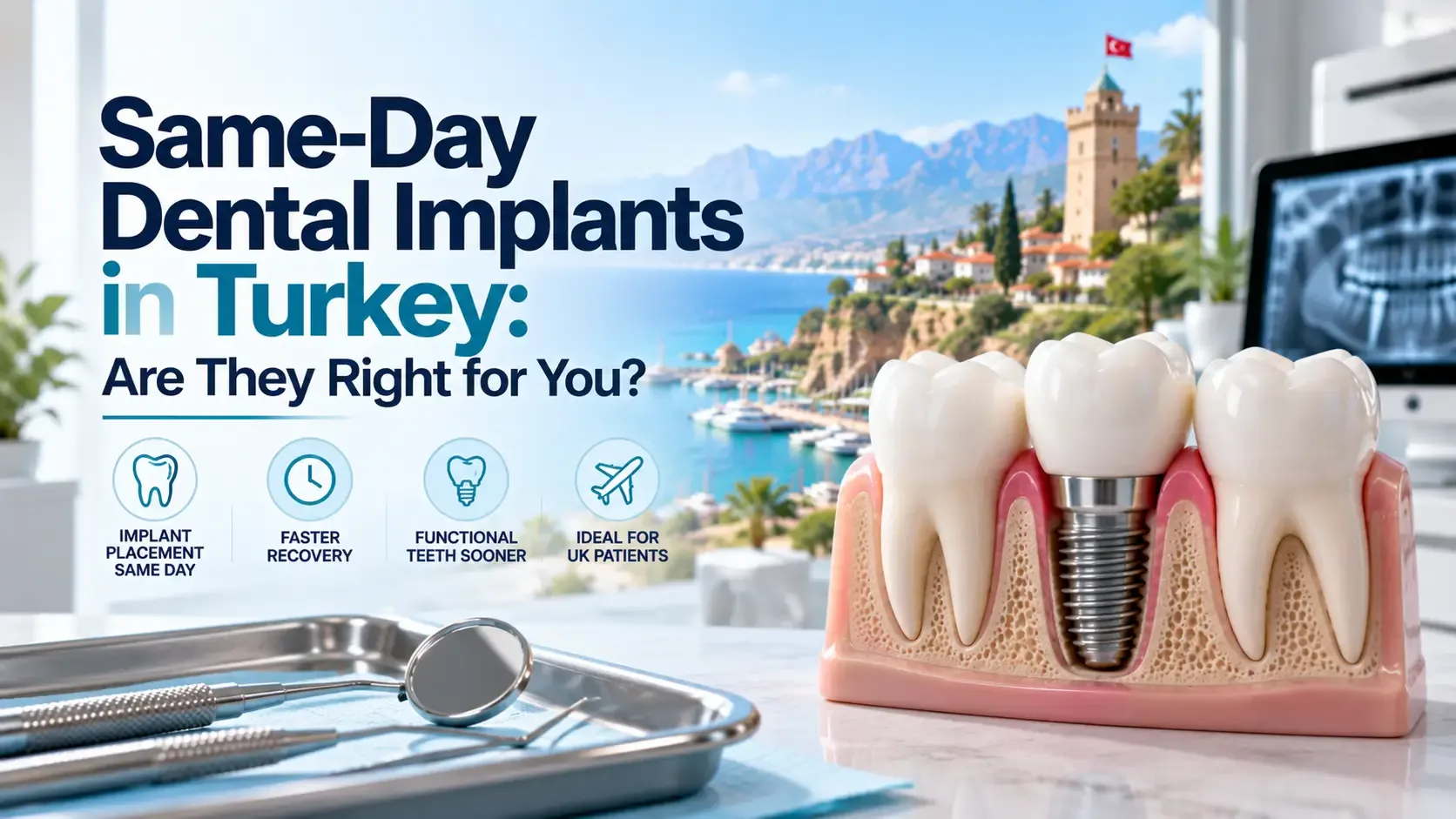
Few phrases are as appealing as same-day dental implants. The idea of leaving the clinic with a tooth, or a new set of teeth, rather than waiting months with a gap is understandably attractive, especially for UK patients who can travel only once or twice. But same day is a phrase that is used in several different ways, and not everyone is a suitable candidate. This guide explains what same-day implants really mean, who they work for, and when a staged approach is the safer and better choice.
What Does Same Day Actually Mean?
The term is used for three different things, and it helps to separate them. First, an implant placed at the same appointment as a tooth extraction, often called an immediate implant. Second, a temporary tooth or teeth attached to an implant on the day it is placed, known as immediate loading. Third, full-arch treatments such as All-on-4, where several implants and a set of temporary teeth are fitted in a single day. These are not the same treatment, and the answer to whether you can have one does not guarantee that you can have the others.
Immediate Implants After an Extraction
Traditionally, a tooth would be extracted and the site left to heal for a few months before an implant was placed. With an immediate implant, the surgeon removes the tooth and places the implant into the socket during the same visit. The main benefit is time, because it can shorten the overall treatment and reduce the number of surgical procedures. It can also help to preserve the shape of the gum and bone around the tooth. It needs enough healthy bone to hold the implant firmly from the start.
Immediate Loading: A Temporary Tooth on the Day
Immediate loading means a temporary crown or bridge is attached to the implant straight away, so you do not have a visible gap. For a front tooth, that can matter a great deal. The temporary tooth is usually kept out of full biting contact while the implant fuses with the bone, which takes a few months. It is not the final result. The permanent crown is fitted later once healing is complete, and the temporary version is a way of getting through the healing period with a natural-looking smile.
Full-Arch Same-Day Treatment
For patients who have lost most or all of their teeth, treatments such as All-on-4 can provide a fixed set of temporary teeth on the day of surgery. The implants are positioned to give good stability together, and a temporary bridge is fitted, usually within a day or so. Final teeth are made after the implants have healed. Our guide to All-on-4 temporary teeth explains what you wear during that period and what to expect while the implants integrate.
Who Is a Good Candidate?
Patients with enough healthy bone to hold the implant firmly at the time of surgery.
Those without a significant active infection around the tooth, or where infection can be safely controlled.
Patients with healthy gums and good oral hygiene.
Non-smokers, or those willing to stop, since smoking raises the risk of implant failure.
People who are in good general health and heal well.
A scan is essential. The decision is made on what the surgeon sees in your bone, not on what you would like to happen.
When a Staged Approach Is Safer
Same-day treatment is not always the best option, and a good surgeon will tell you when it is not. If there is not enough bone, if the tooth has a large infection, or if the implant cannot be held firmly in position, it is usually safer to remove the tooth, let the site heal or graft it, and place the implant later. That approach can take longer, but it gives the implant the best chance of integrating well. Rushing a case that is not suitable for immediate placement can increase the risk of failure.
The Role of Bone Quality and Quantity
An implant has to be stable at the moment it is placed, and that stability depends on the amount and density of bone around it. Back teeth in the upper jaw, for example, often have softer bone and may require a sinus lift or graft. If you have been told you do not have enough bone, read our guide on bone grafts for dental implants, which explains why this is common and how it is managed. A graft does not rule out implants, but it can change the timeline and may mean same-day placement is not appropriate.
Front Teeth and Appearance
The visible front of the mouth is where same-day treatment is most appealing, and where it is most delicate. Gum shape, bone thickness and the position of the implant all affect how natural the final result looks. Skilled planning and a careful approach to the gum around the implant matter far more than speed. With 32 years of dental experience, our view is that a natural-looking result is more important than a quick one, and we will recommend delaying if that is better for the final outcome.
How Same-Day Implants Fit Into a Short Trip
For UK patients, the appeal is obvious. If an implant can be placed at the same time as the extraction, and a temporary tooth fitted, you may need fewer separate trips. Even so, implants need a healing period of several months before the final crown, so you will still usually need a second visit. Our article on first visit versus second visit for dental implants sets out how the two trips are normally divided. Same-day treatment can reduce the number of procedures, but it does not remove the healing time.
Recovery After Immediate Placement
Recovery is usually similar to other implant surgery. Expect some swelling and tenderness for a few days, a soft diet, and careful cleaning of the area. If you have a temporary tooth, you will be advised to avoid biting directly on it and to protect it while the bone heals. Smoking, alcohol and strenuous exercise in the first days should be avoided. Follow the aftercare instructions closely, since the early weeks are when the implant is most vulnerable.
Risks and Honest Limitations
All implant surgery carries some risk, including infection, failure of the implant to integrate, and problems with the gum or surrounding tissue. Immediate placement is not riskier in every case, but it demands good case selection and careful technique. If an implant does not integrate, it can usually be removed and replaced after the site has healed, but this adds time and cost. A trustworthy clinic will explain the risks, tell you what happens if the implant fails and clarify what is covered by its guarantee.
Questions to Ask Before You Commit
Based on my scan, am I suitable for immediate placement, or would a staged approach be safer?
Will I have a temporary tooth, and how will it look and feel?
What implant system will be used, and will I receive an implant passport?
How many visits will I need in total, and when will the final crown be fitted?
What happens if the implant does not integrate?
Cost and What Affects It
Same-day treatment is not automatically cheaper or more expensive than a staged approach. The price depends on the number of implants, the implant system, any grafting needed and the type of temporary teeth. Because immediate placement can reduce the number of surgical procedures, it can sometimes lower the overall cost, but a case that needs additional grafting or a replacement implant can erase that saving. Ask for an itemised written quote that covers the surgery, temporary teeth, final restorations and follow-up, so that you can compare like with like.
Same-Day Implants vs Waiting for Healing: Which Is Better?
There is no universal winner. Immediate placement shortens the journey and can protect your appearance, which is valuable, particularly for a front tooth. A delayed approach gives the site time to heal, allows infections to settle and gives the surgeon more control in difficult cases. Many excellent clinicians use both approaches, depending on the case. The right question is not which approach is better in general, but which is better for your tooth, your bone and your health.
What to Tell Your Surgeon Before Treatment
Tell the surgeon about any medication you take, previous reactions to anaesthetic, smoking habits, medical conditions such as diabetes or heart disease, and any history of gum disease. Mention if you grind your teeth, since heavy biting forces can affect an implant carrying a temporary tooth. Complete information allows the surgeon to decide whether immediate placement is sensible, and to plan the safest approach. Withholding details to qualify for a quicker treatment will not help you in the long run.
Whichever route you take, the most useful thing you can do is to share your scans and history early. The earlier the surgeon sees the full picture, the more accurate the plan and the fewer surprises on the day.
Getting Started
If you're considering same-day dental implants in Turkey, send us a recent X-ray or panoramic scan along with a note of which tooth or teeth are affected. We'll tell you honestly whether immediate placement looks realistic, or whether a staged plan would give you a better long-term result.