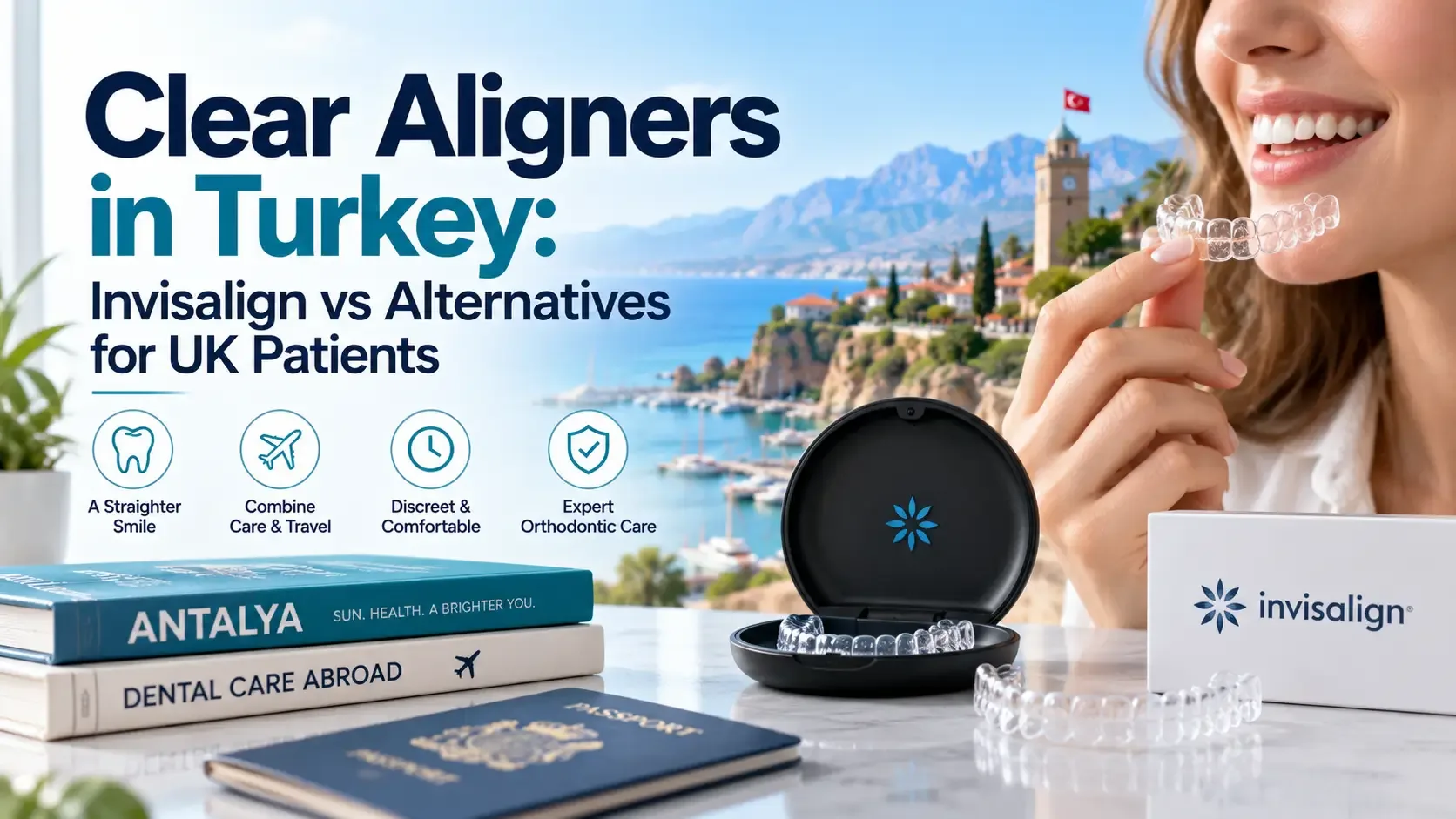
Straighter teeth are one of the most common wishes among adults who contact us, and clear aligners have made that wish much easier to act on. They are virtually invisible, removable and far less disruptive than traditional braces. But unlike a veneer or an implant, aligner treatment is not something you finish in a week. It takes months, and that changes how you need to think about having it done abroad. This guide explains how clear aligners in Turkey work for UK patients, how Invisalign compares with other systems, and how the monitoring side is handled when you are back home.
What Clear Aligners Actually Do
Clear aligners are a series of custom-made, transparent plastic trays. Each one is slightly different from the last, and each moves your teeth a small amount. You wear a tray for most of the day, typically around twenty to twenty-two hours, and change to the next one every week or two, depending on the plan. Small tooth-coloured bumps called attachments are often bonded to certain teeth to help the aligners grip and move them. The treatment is designed on a computer from a digital scan, which means you can see a simulation of the planned movement before you begin.
Invisalign vs Other Clear Aligner Systems
Invisalign is the best-known brand, made by Align Technology, and it has been used on a very large number of patients. It is not the only option. There are other clear aligner systems on the market, some made by established orthodontic companies and some produced by individual clinics or laboratories using their own digital planning. The material, the way the plan is made and the amount of clinical oversight can differ. The important point is that the brand name matters less than the quality of the diagnosis and the plan behind it. A well-planned treatment with a reliable system will beat a poorly planned one with a famous name.
The Honest Case for Choosing Invisalign
Invisalign has a long track record, well-developed planning software and a wide range of treatment options, including for more complex cases. Because it is so widely recognised, a UK dentist who has used it before will usually be comfortable with the system, which can help if you ever need support after you return home. The trade-off is cost. Invisalign tends to be priced higher than many alternatives, and you are paying in part for the brand. For patients with more complicated bite or crowding problems, that track record can be worth paying for.
When an Alternative System Makes Sense
For mild to moderate crowding, spacing or minor relapse after old braces, other aligner systems can produce very good results at a lower cost. Patients also sometimes choose alternatives because the system is designed and supervised by the treating clinic itself, which can make communication easier. The questions to ask are the same whichever system is used: who designs the plan, how are changes handled if the teeth do not move as expected, and what happens at the end of treatment. A clinic should be able to answer those clearly.
Who Is a Good Candidate?
Adults with mild to moderate crowding, gaps or rotated teeth.
People who had braces as a teenager and have noticed their teeth shifting back.
Patients who want a more even smile but do not want to file down healthy teeth for veneers.
Anyone with healthy gums and teeth who is committed to wearing the aligners consistently.
Aligners work well only when they are worn. If you are unlikely to keep them in for most of the day, treatment will take longer or may not deliver the result you hope for.
When Aligners May Not Be Enough
Some problems are more difficult to correct with aligners alone. Significant bite discrepancies, severe crowding, certain tooth rotations and some jaw problems may need traditional braces, a combination of treatments, or even surgery. A proper assessment should tell you this honestly rather than promising a result that the system cannot deliver. If your gums are not healthy, they will need to be treated first, because moving teeth in an inflamed mouth can make matters worse. With 32 years of dental experience, we would rather tell you early that aligners are not the right tool than let you invest months in a plan that disappoints.
The Big Question: How Does Treatment Work When You Live in the UK?
This is the part most patients worry about, and it deserves a straight answer. Clear aligner treatment typically involves an initial assessment, digital scans, a treatment plan, the fitting of attachments, and then regular check-ups across several months. You cannot do all of this in one short trip. The usual model is that you attend in Turkey for the assessment, scan and fitting, receive your aligners in stages, and then either return for in-person reviews at intervals or have your progress monitored remotely with photos and digital check-ins. Complex cases need more in-person oversight than simple ones.
How Remote Monitoring Works
With remote monitoring, you send photos of your teeth and aligners at set intervals, and the clinic reviews how closely the teeth are following the plan. Some systems include apps that guide you through taking the right photos. If the teeth are tracking well, you move on to the next aligners as planned. If they are not, the plan may need adjusting, which can mean new scans or a refinement phase. This works well for straightforward cases and motivated patients, but it is not a replacement for in-person checks when something is not going to plan.
The Role of Your UK Dentist
It is sensible to tell your regular dentist that you plan to have aligner treatment abroad. A UK dentist can keep an eye on your gum health and general oral hygiene while the treatment is in progress, and can help if you lose or damage an aligner. Not every UK dentist is willing to take on responsibility for a treatment they have not planned, so it is better to ask early. Having a local contact for routine check-ups, combined with clear communication with your Turkish clinic, is the most reliable way to handle the distance.
How Long Does Treatment Take?
Mild cases can be completed in as little as six months, while more involved cases often take twelve to eighteen months or longer. The timeline depends on how far the teeth need to move, how consistently you wear the aligners and whether refinements are needed along the way. Be wary of any clinic that promises very fast results without seeing your scan. After the active phase, you will need retainers to hold the teeth in their new position, and wearing them as advised is what keeps the result stable in the long run.
Aligners Before Veneers or Smile Design
Aligners are not only a stand-alone treatment. Many patients use them to move teeth into a better position before veneers or crowns, which can mean thinner restorations and the preservation of more natural tooth. If you are considering a smile makeover, it is worth asking whether straightening first would give you a better and more conservative outcome. This is a decision that benefits from a single clinic looking at the whole picture, rather than separate treatments planned in isolation.
Questions to Ask Before You Commit
Which aligner system will be used, and why is it right for my case?
Who will design and approve my treatment plan?
How often will I need to attend in person, and how will remote reviews work?
What happens if my teeth do not move as planned? Are refinements included?
What retainers are included at the end, and how are future replacements handled?
What will I need from my UK dentist, if anything?
Is It Worth Having Clear Aligners in Turkey?
For the right patient, yes. If your case is mild to moderate, you are disciplined about wearing the aligners and you are comfortable with a mix of in-person visits and remote monitoring, the savings can be significant without sacrificing quality. If your case is complex, or you would prefer regular face-to-face reviews, a local orthodontist may be a better fit. The most valuable first step is an honest assessment based on your own scan, not a general promise.
Caring for Your Aligners and Teeth During Treatment
Good habits make a visible difference to how smoothly treatment goes. Aligners should be removed for eating and drinking anything other than plain water, and your teeth should be brushed before the trays go back in, otherwise food and sugar are trapped against the enamel. Clean the aligners daily with a soft brush and lukewarm water, never hot water, which can warp them. Keep the case with you so aligners never end up wrapped in a napkin, which is how many get thrown away by accident. Patients who follow these simple routines usually finish on time, and with healthier gums than when they started.
Getting Started
If you're considering clear aligners in Turkey, send us a few clear photos of your teeth, front and side, along with any previous orthodontic history. We'll let you know whether aligners look suitable, which systems are worth considering and how the monitoring would work from the UK, so you can make a decision with realistic expectations.